Affiliated to CISCE New Delhi (Home Centre for ICSE & ISC)
Affiliated to CISCE New Delhi (Home Centre for ICSE & ISC)

October 1, 2026
HSMS
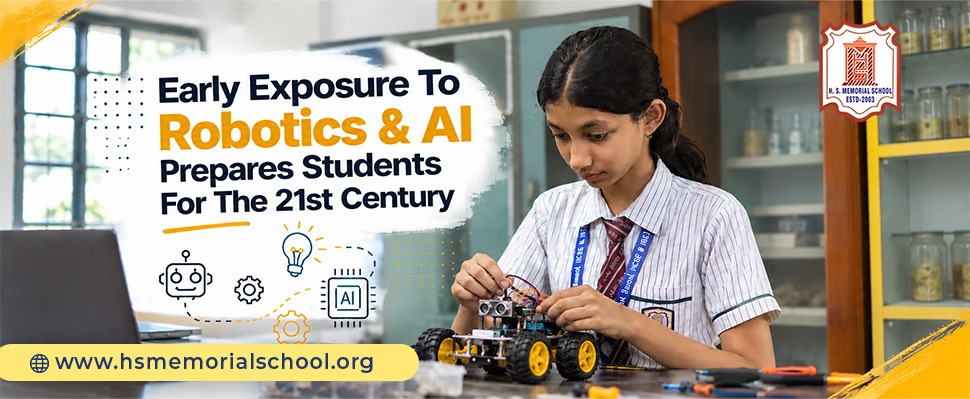
Walk into a traditional classroom, and you will likely see students reading from textbooks, writing notes, and preparing for tests. But step into a modern robotics lab, and the energy is completely different. You will find eight-year-olds huddled around a table, debating why their small motor won’t turn, testing code on a tablet, and cheering when their robot finally moves three inches forward.
That shift—from consuming information to actively building solutions—is precisely why technology education has changed so drastically over the last decade.
Not too long ago, Artificial Intelligence and Robotics were subjects saved for engineering colleges. Today, introducing young learners to these fields early in their school journey is no longer a luxury or an gimmick; it’s one of the most practical ways we can prepare children for an unpredictable future.
At HS Memorial School, through initiatives like our AI U Robotic and coding programs, we see daily how hands-on tech education transforms the way children think, learn, and grow.
Here is why early exposure to Robotics and AI matters so much for the next generation.
Most kids today are digital natives. They know how to swipe on a smartphone, navigate YouTube, and play complex video games before they even learn to ride a bike. But there is a massive difference between using technology and understanding it.
When children learn basic block coding or construct a simple sensor-driven robot, the “magic” behind the screen disappears. They start asking bigger questions: How does a smart door know when to open? Why did my app suggest that video?
Early exposure turns passive screen time into active creation. Instead of just consuming content created by someone else, students realize that they have the power to build, design, and control technology themselves.
In standard academics, making a mistake often means losing marks on a paper. It can create anxiety around being wrong.
Robotics and coding completely rewrite that mindset.
When a student programs a robot to walk straight and it spins in circles instead, nobody panics. They don’t look at it as a failure; they look at it as a bug that needs fixing. Debugging teaches patience, resilience, and trial-and-error. Kids learn to analyze what went wrong, tweak the code, and try again until it works. This persistence—learning not to give up when something fails on the first try—is a essential life skill that stays with them far beyond the classroom.
How many times have parents heard the question, “Why do I need to learn this math formula?”
Robotics gives immediate, tangible answers to that question. Suddenly, concepts like geometry, angles, distance, and logic aren’t just abstract ideas on a blackboard—they are tools needed to make a robot turn 90 degrees without crashing into a wall.
By blending Science, Technology, Engineering, and Math (STEM) with real-world activity, children naturally grasp complex concepts because they see them working right before their eyes. It bridges the gap between theoretical textbook knowledge and practical application.
People often assume that AI and robotics are purely technical fields reserved for “math minds.” In reality, engineering is deeply creative.
Building a robot requires imagination. How should it look? What problem should it solve? How can we design it to be lightweight yet sturdy? Combining logic with creative design encourages whole-brain thinking. A child who loves drawing or building with blocks often finds robotics just as exciting as a child who loves solving arithmetic problems.
Think back twenty years ago—roles like Data Scientist, Cloud Architect, AI Specialist, or Drone Pilot barely existed. The job market is changing faster than ever, and many of the professions our primary school students will hold in the future haven’t been invented yet.
We can’t teach children the exact software or tools they will use fifteen years from now because those tools will evolve. But what we can teach them is how to adapt, how to think logically, and how to embrace new technology without fear. Early exposure to AI and robotics builds adaptability, ensuring that no matter how much the world changes, our students won’t just keep up—they will lead.
Building Future Innovators at HS Memorial School
At HS Memorial School, our goal isn’t to turn every single child into a computer engineer or a roboticist. Our goal is to nurture confident, curious, and creative thinkers.
Through our activity-based learning approach—combining foundational logic through tools like Abacus Smart Math with forward-looking modules like coding and AI Robotics—we give our students the balanced foundation they need to thrive in the 21st century.
When we give young minds the space to experiment, build, and innovate today, we are giving them the confidence to shape tomorrow.